Links
Breakfast links: A high idea
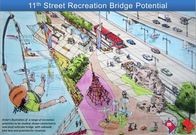
11th Street recreation bridge?: One of the old spans of the 11th Street bridge could become a "recreation bridge", a sort of High Line for DC. There's a meeting on March 28. (TheWashCycle)
Buses rise, rail stays flat: Metrobus ridership increased dramatically in 2011, rising 7.1% over 2010. Metrorail ridership, however, stayed essentially flat. The trends coincide with a national increase in public transit use. (Post, NYT)
Adams Morgan work nearly complete: The root canal that is Adams Morgan's streetscape improvement project is nearing its end, with the last touches to finish this summer. Still, business has slowed considerably in the neighborhood. (Post)
Concerns up the pike: Columbia Pike residents are concerned proposed development along the corridor will simply gentrify it, pushing out low-income families and destroying affordable housing. (Post)
One for the money: Governor McDonnell is still trying to find more road funding, though the most prominent ideas—indexing the gas tax to inflation or diverting some sales tax revenue—are dead in the Virginia legislature for now. (Post)
Marbury Plaza saga (sorta) ends: The run-down Marbury Plaza apartments on Good Hope Road SE have been mostly fixed up, and rents in escrow have been released to the owners. Some tenants feel there is still a lot of work to do. (City Paper)
More real-time info, please: WMATA has made great strides in its marketing and social media outreach, but it should put the really practical data, especially Metro delays and arrivals, on the air and outside stations where everyone can see them. (RPUS)
How to prevent bus bunching: Researchers have devised a system they say will better reduce bus bunching: Just let buses flow with traffic, and add dynamically timed pauses. (Atlantic Cities)
Have a tip for the links? Submit it here.
Comments
Cyclists are special and do have their own rules
- Cyclists are special and do have their own rules
- M Street cycle track keeps improving, draws church anger
- Judge denies injunction against closing schools
- O'Malley announces first projects using new gas tax money
- ICC losing bus service in classic bait and switch
- Silver Spring mall could get massive facelift, new name
- Can Loudoun grow while protecting its rural areas?
Tue May 21
Sun May 26
11:00 am Roosevelt Ride in Greenbelt
Sat Jun 1
10:00 am CSG walking tour of Wheaton


by Gray on Mar 13, 2012 8:29 am • link • report
More true: another article on WMATA that didn't mention the pension system as driving the expense.
by charlie on Mar 13, 2012 8:32 am • link • report
by Froggie on Mar 13, 2012 9:11 am • link • report
I'm thinking Purple Line here. MTA has an operational analysis that they say shows they cannot single-track even for a few hundered feet in the Bethesda Tunnel, because they need to have long "dwell time" built into the schedule at the Bethesda Station to regulate their train schedules. But I think they are assuming only two "control points", at the end of the line at Bethesda and at New Carrollton.
The study on bus bunching suggests the Purple Line might achieve better regulation if they added more control points (say at major stations like College Park, Langley Park, Silver Spring) and used dynamic pauses. If that will work, then the "dwill time" needed at Bethesda could be greatly reduced, single-track could be used in the tunnel without compromising the 6 minute headway goal, and the Capital Crescent Trail could stay in the tunnel alongside the single-track section.
Far fetched? Maybe. But worth a look when there so much at stake for the CCT in Bethesda.
by Wayne Phyillaier on Mar 13, 2012 9:12 am • link • report
by charlie on Mar 13, 2012 9:16 am • link • report
On the flip side, I'm sure WMATA will claim a huge success when total ridership spikes upward with the opening of the Silver Line.
by Falls Church on Mar 13, 2012 9:27 am • link • report
by ah on Mar 13, 2012 9:31 am • link • report
"Adams Morgan's"? I would've gone with "The Adams Morgan root canal that is the streetscape improvement project..." just to avoid having to try to make Adams Morgan possessive.
by dc denizen on Mar 13, 2012 9:46 am • link • report
Well, I can tell you that weekend ridership of the Red Line certainly hasn't fallen "marginally." Walking's often faster than taking the train when there's work being done on the Red Line.
by andrew on Mar 13, 2012 10:40 am • link • report
"Yep, but we have endless debates on this blog that transit pricing doesn't matter. Just make it more expensive."
I'm not sure what you're talking about, but pricing definitely does matter. Are you saying that someone has argued here that transit demand is perfectly inelastic?
by Gray on Mar 13, 2012 10:44 am • link • report
BOTH spans are on-schedule to be demolished by Skanska-Facchina this summer.
The old 11th St Bridges were built with a design that is now known to be inherently unsafe, and the bridge deck of the existing outbound freeway bridge is considerably higher off of the water than the new Local bridge will be.
This concept would require the existing deck to be removed, and a new deck be installed closer to the water (presumably by shortening the piers), and also somewhat wider so that it could can match up with the new local bridge. You'd also have to do something about the abutments at either end, which are both a considerable height off of the ground.
And, all this for what? Connecting the Navy Yard and Washington Gas hazmat site with Poplar Point and Anacostia Park? That's the whole purpose of the new Local bridge! Until Washington Gas cleans up their site or the Navy decide to pack up and call it quits, development around the northern end of the bridge is going to be very minimal.
I can buy the argument that we might as well keep the bridge piers around; they might be useful someday. However, for now, there are many other pie-in-the-sky projects around the river that would cost much less, and have far more merit (ie. a bike/ped connection across the river along the CSX tracks).
The time to propose and plan this project passed about 5 years ago. There was a lengthy public comment period surrounding the reconstruction of the 11th St bridges, and I don't believe that this idea was ever pitched.
by andrew on Mar 13, 2012 10:53 am • link • report
Same goes for bus; I wonder how much bus revenue is up vs. ridership.
by charlie on Mar 13, 2012 10:55 am • link • report
Framing discussions in terms of revenue or profit is not a great exercise in the first place.
In fact, it's difficult to have any sort of discussion about off-peak Metrorail ridership right now. The service patterns are constantly in flux, and should eventually return to normal.
A better way to frame things would be: "We were forced to decrease the level of service, and haven't seen a drop in ridership yet."
Still, this doesn't bode well for Metro. Remember that the system lost almost an entire week of ridership in 2010 due to the snow. If we got similar numbers in 2011 (which had no weather events that closed the system), ridership effectively declined.
(Oh, and what's with that bus bunching study? Have they tried their algorithm on a route with more than 3 buses? Sure, they improved headways, but the route that they tested it on already had fairly good headways to start... This sounds kind of similar to WMATA's new strategy for the 90/92/93 line, which, while still far from perfect, seems to have been fairly successful so far.)
by andrew on Mar 13, 2012 11:11 am • link • report
by charlie on Mar 13, 2012 11:16 am • link • report
by Johnny on Mar 13, 2012 11:23 am • link • report
By what metric has it been successful? I find along U street that the 90/92/96 are constantly bunched. Service has been reduced past 14th street from the 92 buses turning around, and there's no point in walking to 14th to catch a 92 since the 90 and 92 seem to leave in packs for some reason.
Just take a look at the live map on Nextbus any day and you'll see buses right behind one another with big gaps. I thought the headway idea was a good one but WMATA seems unable to keep the buses on headway given that they have multiple overlapping services with multiple start points.
by MLD on Mar 13, 2012 11:29 am • link • report
by Gray on Mar 13, 2012 1:44 pm • link • report
I agree that Purple Line operational capabilities should not be allowed to be seriously restricted.
But I am proposing that this alternate method be given a serious evaluation to see IF it can maintain the headways and throughput the Purple Line needs, even with one very short single-track section. Why should we be afraid to look at least look at this to see if it will work?
As for the "for decades to come" I would point out that a major reason for dropping an alternate proposal to redevelop the Air Rights Building, so a wider station could be built at the same time the building is rebuilt, is that the time schedule for building the Purple Line by 2020 does not give time to coordinate with the building redevelopment. But the Air Rights Building is already aging and will not continue to survive "for decades to come". When the Air Rights building is redeveloped in the future a more spacious station can be built and the single track section can be removed.
by Wayne Phyillaier on Mar 13, 2012 2:08 pm • link • report
The riders per train metric was meant to measure transit demand, not justify fare increases. The relevant metric for fare increases is operating deficit. The deficit has to be plugged with additional monet (fares or subsidy) or decreased costs.
The riders per train metric is meant to factor into an altogether different debate about transit vs. roads.
by Falls Church on Mar 13, 2012 2:16 pm • link • report
Why can't the design dwell time be increased from 6 minutes to something like 9 minutes, so that an incomming train would have to be 4 minutes late (instead of 1 minute late) before it has to wait for the outgoing train (and thereby have its dwell reduced to 2-3 minutes which would probably cause it to leave Bethesda late.
Jim
by Jim T on Mar 13, 2012 2:19 pm • link • report
I don't completely understand the operational simulation, but I think the interaction between incoming and outgoing trains is more complex than that. There will be two tracks at the platform itself, one on each side of the platform. (There is a little more width available at the platform location than under the Air Rights Building.) The Purple Line would be single-track only on the approach to the platform. A second train can enter the station and take the second track position at the platform. The first train does not have to leave to make room for the second train at the platform, but it would have to hold long enough to allow an incoming train to clear the single-track section.
by Wayne Phyillaier on Mar 13, 2012 2:40 pm • link • report
@Wayne: You do realize that "dynamic pauses" are another way to describe lengthening trip times, right?
by Gray on Mar 13, 2012 3:53 pm • link • report
9:00 Train on track 1 departs while train on track 2 stays
9:01 Train leaving on track 1 passes the crossover
9:02 Train arriving on track 1 passes the crossover
9:03 Train arrives on track 1.
9:06 Train on track 2 departs while train on track 1 stays
9:07 Train leaving on track 2 passes the crossover
9:08 Train arriving on track 2 passes the crossover
9:06 Train arrives on track 2.
9:12 Train on track 1 departs while train on track 2 stays
9:13 Train leaving on track 1 passes the crossover
9:14 Train arriving on track 1 passes the crossover
9:15 Train arrives on track 1.
and so on
Note that the arriving trains could be a few minutes late and it would just shorten the dwell time.
by Jim Titus on Mar 13, 2012 9:48 pm • link • report
That seems like the simplest and safest solution to a problem that doesn't exist.
by Gray on Mar 14, 2012 8:55 am • link • report
Do you work in rail operations? Because I'm pretty sure you can't run trains that close together. You have no buffer room in there so if something goes wrong your entire operation is screwed. One minute a train passes through a switch going one direction and the next minute a train goes through in the opposite direction? Doesn't work.
by MLD on Mar 14, 2012 8:58 am • link • report
@Gray. Why the sarcass? I've answered what I assumed to be a reasonable question and instead of engaging in substance you switch to ridicule. (Or was your original question rhetorical and I misconstrued it as substantive.) Whether you think there is a problem or not, many people would like to see both a trail and light rail in that tunnel and are looking to see what is feasible.
@MLD. I'm not sure if you read MTA's analysis of how they would do it. I think all I have changed is the dwell time, and rounded things off to the nearest minute.
As you probably realize, the problem of crossovers timed to the minute is something that Metrorail faces at the end of the line. They have run trains with 5-minute headways, and while their crossovers are short, their trains are long, so the time it takes to travese the crossover is about the same.
and their trains are longer
Perhaps you could explain more why you doubt the feasibity of these crossovers
If you really want to get at what is feasibl;e
If you don't like my notation and level of rounding, try explaining in your own words how Metrorail has been able to run trains with a crossover and headways with 5 minutes, recognizing how much longer their trains are
by Jim Titus on Mar 14, 2012 9:41 am • link • report
by Jim Titus on Mar 14, 2012 9:42 am • link • report
That's why I was suggesting that the dwell time be increased from 6 minutes to 9 minutes. With 9 minutes, if the incoming train is 3 minutes late and that outgoing train is 2 minutes late, the incoming train can wait for the outgoing train, and still come in with a dwell time of about 3 minutes for an on time departure.
by Jim Titus on Mar 14, 2012 9:48 am • link • report
Add a Comment