Bicycling
Lack of connections, visibility hurt ICC Trail
Less than a year old, the Intercounty Connector Trail offers a new way to get across Montgomery County by bike. However, a circuitous route, a lack of connections to surrounding areas, and sections with poor visibility all hurt its potential.
The ICC was originally planned to have a bike trail running parallel to it, but in 2004, the State Highway Administration got rid of it, claiming it would reduce the toll road's construction costs and environmental impacts. Instead, they gave the ICC Trail a more circuitous and indirect route, running parts of it along the highway and the rest along local roads like Columbia Pike and Briggs Chaney Road.
Not surprisingly, area bicyclists were unhappy with the decision. "Why do designers think cyclists should have to go the long way, but cars need a direct route?" asked WashCycle.
Part of the trail runs parallel to Columbia Pike between Fairland Road and Briggs Chaney Road in East County. Like the Forest Glen pedestrian bridge that crosses the Beltway, it runs under a highway. As a result, the trail is also lightly used and has already been vandalized.
This is unfortunate, because the trail could tie neighborhoods on both sides of the ICC together and is a crucial part of a "commuter bikeway" along Columbia Pike first envisioned in master plans 15 years ago. But this part of the ICC Trail won't get any busier or safer without better foot and bike connections to get people to it.
Let's take a look at the trail:
Here we are on the trail, just north of Fairland Road. That's the exit sign for the InterCounty Connector up ahead.
First we pass this small seating area. People do use it, judging from the abandoned pair of shoes. I enjoy the dry stacked stones and wooden bench, which give the trail a woodsy, rustic feel despite its surroundings. Behind the seating area is the recently-built Fairland View subdivision.
The development is separated by a grass berm and has no connection to the trail, despite being yards away. (The view, of course, is of the InterCounty Connector.) I assume these nearby chalk drawings came from kids living there.
Now we're heading under the interchange between Columbia Pike and the ICC. This part of the trail is almost invisible from either road and the surrounding houses, and I passed a group of young men smoking right before I took this picture.
There is Sharpie graffiti in the tunnel, though it's not much worse than anything I saw or did myself in high school. The tunnel appears to have been repainted a few times since it opened; in fact, since I took this photo, the scribbles have already been painted over. It's good to see that the state is maintaining the trail, though I wonder how regularly they patrol it.
After the tunnel, we go under a couple of overpasses. The roar of traffic is pretty intense, and I noticed some broken glass on the path where lights have been knocked out.
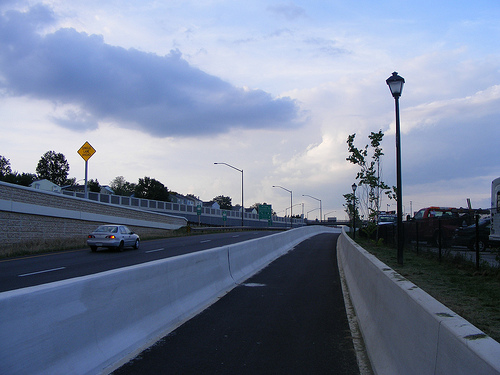
We're now between Columbia Pike on the left, and the Montgomery Auto Park on the right. Turn around and you get a great view of the interchange. There are maybe waist-high concrete walls on either side of the trail and a chain-link fence separating it from the Auto Park. The wall might keep bicyclists safe from car traffic, but I wonder if it's also there to protect the car dealerships from bicyclists.
And then we hit a wall. This is the interchange of Columbia Pike and Briggs Chaney Road, which was completed about four years ago; the trail takes a hard right to get around it and then joins Briggs Chaney Road.
Across the street is the Briggs Chaney Plaza shopping center; there's a stoplight and intersection in front of us, but no pedestrian signal or even a crosswalk. From here, we can continue down Briggs Chaney, which has a nice, wide shared path for about a mile and a half before connecting to a portion of the trail that's actually on the ICC.
Residents of Tanglewood, a subdivision on the south side of the ICC, complained that a trail would invite "criminals" from the apartment complexes along Briggs Chaney Road. While I still think that accusation was unfair, residents' predictions that there would be vandalism on the trail turned out to be true.
But as WashCycle points out, the best way to make a safe trail is to make it busy. In the handful of times I've used this one-mile portion of the ICC Trail, I've seen maybe a dozen people there. The trail is new enough that some people haven't heard of it, but it's also obscured by a highway interchange and sound berms.
It would've been ideal if the State Highway Administration had laid out the trail first and then worked around it, rather than the other way around. The trail would be more direct, and possibly more visible, while having little or no effect on the ability of drivers to pass through.
Since that opportunity no longer exists, the best thing we can do is to improve foot and bike connections to nearby destinations like Briggs Chaney Plaza and neighborhoods like Castle Boulevard, which recently got new sidewalks and medians. The easier it is to walk or bike in the area, the more likely people are to use the ICC Trail, and the less destructive behavior will occur.
Comments
- Latest Metro map drafts add Anacostia parks and other tweaks
- Bikeshare is a gateway to private biking, not competition
- Short-term Washingtonians deserve a voice, too
- DC Council makes major policy changes overnight
- Judge denies injunction against closing schools
- Public land deals have both benefits and pitfalls
- Parklets give every block a little park


by selxic on Jun 29, 2012 11:32 am • link • report
I think it was important for the trail to be built, from a complete streets infrastructure standpoint, but you run into the general problem of likelihood of use.
http://www.montgomeryplanning.org/transportation/bikeways/documents/Bike-Heat-Map-2011-08-17.pdf
But that's still no excuse to not build the right connections to neighborhoods. What is potentially won't be achieved without the right connections, except by the hardiest riders.
While not exactly the same context, these plans show a different way, of trails as connectors between neighborhoods and commercial districts and other civic assets:
- also the NW Branch Trail between Rte. 1 and West Hyattsville Metro
- Cynwyd Trail, Lower Merion Township, PA
- Redmond Connector, WA
The Met. Branch does it too, somewhat.
by Richard Layman on Jun 29, 2012 11:36 am • link • report
Instead of attacking the ICC trail, you should be praising it. How many freeways in the area have an adjacent trail at all, especially a high-$$$ one traveling through lower density suburbs? I absolutely guarantee you that Gov McDonnell in fascist Virginia has no plans for including any trails in his Outer Beltway plans.
Here's an idea: Maybe once in a while you could write a piece praising something in our area.
by Why??? on Jun 29, 2012 1:08 pm • link • report
I think the article sounds harsher than Dan really means it to be. I think he's raising important points of reference for future infrastructure. Maybe the part about the actual route could be tempered, but the points about the lack of connection to anything else is very valid. It's probably a great trail to get a nice 30 mile ride in (round trip), but why not have the trail connect to the adjacent neighborhoods and roadways, to get more people using it? The excuse will be it's not in the States requirements to do anything more than build the trail, and the connections are the responsibility of the County, or the development HOA's/developers. I'd imagine any new developments adjacent to the trail would be made to connect, but it will be up to the County to build the old connections, and that is money that they really don't have right now. I've not looked into some of the on-street issues personally, but it also does seem pointless to build a trail that has no safe roadway crossings. That should take first priority in any future improvements.
by Gull on Jun 29, 2012 1:26 pm • link • report
Have you heard of Complete Streets? http://www.completestreets.org/
I believe MD is a state that has adopted Complete Streets (CS) as have PG Co. and Mont.Co.
Even the CS policy does not place biking and walking infrastructure as the first priority, it only says that where a roadway for automobiles is being built/renovated some thought and effort for walking and biking safety should be considered. Even in CS its automobile centric transportation that is catered too first and foremost. How self-righteous and self-important of car drivers!
by Tina on Jun 29, 2012 1:31 pm • link • report
Or this? http://greatergreaterwashington.org/post/15196/montgomery-council-votes-for-townhouses-at-chelsea-school/
Or this? http://greatergreaterwashington.org/post/15105/better-streets-buildings-boost-walking-in-briggs-chaney/
Or this? http://greatergreaterwashington.org/post/15057/plan-revitalizes-burtonsville-with-housing-street-grid-parks/
by David Alpert on Jun 29, 2012 1:36 pm • link • report
I-66, GW Parkay, Fairfax County Parkway, VA-123, The Clara Barton Parkway, Rock Creek Parkway, Beach Dr, Anacostia Freeway, Ritchie Highway.
So, to summarize: More than you thought.
by Jasper on Jun 29, 2012 2:03 pm • link • report
However, you left out a very important one that seems to be getting decent utilization - the Capital Beltway, at least crossing the Woodrow Wilson Bridge and with connections from Md. 414 (Oxon Hill Road); Va. 400 (South Washington Street); U.S. 1 (Richmond Highway); and the Mount Vernon Trail.
by C. P. Zilliacus on Jun 29, 2012 2:39 pm • link • report
The ICC was originally planned to have a bike trail running parallel to it, but in 2004, the State Highway Administration got rid of it, claiming it would reduce the toll road's construction costs and environmental impacts.
I also blame the staff at M-NCP&PC in both counties for not pushing for a complete trail - hard - all the way from U.S. 1 (Baltimore Avenue) to Shady Grove, including grade-separated bike crossings of I-95; U.S. 29 (Columbia Pike) and Md. 97 (Georgia Avenue).
The segment that Dan highlights under Md. 200 just east of U.S. 29 is, I believe, more about north-south (U.S. 29) bike traffic than it is about east-west (Md. 200) movement.
Somewhat annoyingly, there are disconnected segments of the ICC trail that have been built - between Notley Road and Md. 650 (New Hampshire Avenue); and between Briggs Chaney Road and Old Gunpowder Road.
by C. P. Zilliacus on Jun 29, 2012 2:46 pm • link • report
Sorry. I-95 and I-495 added. And since the Anacostia Freeway is I-295, we can conclude that I-66, I-95, I-295, I-495 and I-695 all have trails along them. That leaves I-395 and I-270 as the two interstates without a trail next to them.
The answer to Why?? then becomes: Most.
by Jasper on Jun 29, 2012 2:47 pm • link • report
by Richard Layman on Jun 29, 2012 2:57 pm • link • report
by Tina on Jun 29, 2012 3:02 pm • link • report
by Greenbelt on Jun 29, 2012 3:06 pm • link • report
by Richard Layman on Jun 29, 2012 3:48 pm • link • report
http://www.washingtonpost.com/wp-dyn/content/article/2008/10/07/AR2008100703245_2.html?sid=ST2008100703347
by Tina on Jun 29, 2012 4:09 pm • link • report
As a north-south trail, the part along Rt. 29 under the ICC is great, but it's usefulness is limited by the fact it really get you very far. To travel along Rt. 29 for any distance on a bike you have to use a combination of roads, bike lanes, paths, and scary sidewalks. A mile of path in the midst of that isn't going to get any recreational use at all.
by Jack Cochrane on Jun 29, 2012 5:20 pm • link • report
- The county is doing initial planning for construction of the missing ICC trail segment from Layhill Local Park (on Layhill Rd) to Bonifant Road -- through the old trolley museum property more or less. The trail will then be built along Bonifant (not too bad) and Notley Road (semi-tolerable) to reconnect with the existing ICC trail at Notley. When that's all complete, trail users will be able to get from Needwood Road to New Hampshire Ave without any truly horrible sidepaths.
- The county has already put into their six-year budget a sidepath along Needwood Road to connect the ICC trail to Rock Creek Park. Then trail users will be able to start in Rock Creek Park or anywhere along the Rock Creek trail.
by Jack Cochrane on Jun 29, 2012 6:01 pm • link • report
The comments do remind me of a conversation (when I was working for Baltimore County) I had with a colleague who works for the MD Dept. of Planning. He described an ICC planning meeting with his department and MDOT Sec. of the time Robert Flanagan and his people. My colleague and others advocated for the trail, strongly. Flanagan was super pissed. The Dept. of Planning was ordered to back off on the trail at the threat of their jobs.
Secretary Flanagan, like it or not, was under orders from his boss, then-Gov. Bob Ehrlich, to get his administration's highest priority highway project built - or at least to get the environmental impact statement done to a record of decision.
You can be critical of Flanagan for not putting strong emphasis on the ICC trail (in the scheme of things, this multi-user trail is not a very expensive project as compared to a six-lane freeway), but as I suggested above, I believe the blame lies with the staff at the Maryland-National Capital Park and Planning Commission in both counties (and their bosses at the respective Planning Boards and County Councils) for not pushing hard for a master-planned transportation improvement) - all the way from Shady Grove to U.S. 1 - which is what the ICC trail was (and presumably still is).
There were also objections to the trail raised by regulatory staff from the U.S. Army Corps of Engineers - the ACE especially objected to the trail segment between Md. 650 (New Hampshire Avenue) and Old Columbia Pike, across the Paint Branch (of the Anacostia River) watershed.
by C. P. Zilliacus on Jun 29, 2012 6:08 pm • link • report
by Jack Cochrane on Jun 29, 2012 6:26 pm • link • report
by Kristina on Jun 29, 2012 6:48 pm • link • report
I-66, GW Parkay, Fairfax County Parkway, VA-123, The Clara Barton Parkway, Rock Creek Parkway, Beach Dr, Anacostia Freeway, Ritchie Highway.
So, to summarize: More than you thought.
Yeah and how many of those are "high-$$$ ones traveling through lower density suburbs?"
To summarize: none.
...and your notion of "freeway" (Rock Creek Pwy and Beach Dr?!) and "adjacent" is pretty interesting.
by Why??? on Jun 29, 2012 7:09 pm • link • report
Yeah and how many of those are "high-$$$ ones traveling through lower density suburbs?"
In the case of the ICC and the ICC Trail, they were both master-planned improvements appearing in every master plan through which the ICC passes. Regardless of the land use densities.
At least in Maryland, master-planned is supposed to mean legally binding, though federal environmental regulatory staff (especially the U.S. Army Corps of Engineers, Baltimore Engineering District; EPA Region III in Philadelphia; and the Fish and Wildlife Service) repeatedly demonstrated contempt for approved and adopted master plan documents through the (seemingly endless) ICC studies and environmental impact statement processes as far back as the 1970's. And that contempt includes the ICC multi-use trail.
I already stated above that planning staff in both counties should have been much more proactive in supporting a complete ICC trail, and in some cases [inexcusably] opposed it, in other cases failed to advocate for it.
by C. P. Zilliacus on Jun 30, 2012 9:43 am • link • report
I enjoy your articles (all of them) but was wondering if you could include more maps in your articles, especially relating to areas and transportation around the area. I'm relatively new to DC and having a map of the ICC trail would help me to understand where things are. Thanks!
The Wikipedia article about the InterCounty Connector (Md. Route 200) has a good overview map - please click here for the article.
by C. P. Zilliacus on Jun 30, 2012 9:49 am • link • report
WashCycle posted a map in 2008 from the study. This shows, for instance, the route parallel to Columbia Pike for a while that Dan was talking about.
http://washcycle.typepad.com/.a/6a00d8345198c369e2010536e75c42970b
Anyone know where there is a better map?
by David Alpert on Jun 30, 2012 10:03 am • link • report
cyclemoco.com/2011/12/icc-trail-along-needwood-road-five-years-if-were-lucky/
Click on the map to enlarge. Lots of colors so its not so easy to use for riding, but it's all there.
by Jack Cochrane on Jun 30, 2012 1:10 pm • link • report
To summarize: none.
Well, none except those along the Fairfax County Parkway, and VA-123 (Ox Road). As far as I know, there is no dense living around the Woodrow Wilson bridge either, unless you count fish. Nor long the GW Parkway, except for Crystal City and Alexandria. But Arlington Cemetery is generally quite dead, nobody lives at Haines Point or the airport, and you can't call the upscale villas in Belle Haven and Mt Vernon high density either. Nobody lives along the Clara Barton Parkway either.
So... Plenty. Please look at a map before spewing nonsense.
by Jasper on Jun 30, 2012 2:38 pm • link • report
by selxic on Jul 2, 2012 12:03 pm • link • report
by David C on Jul 2, 2012 2:28 pm • link • report
by B_76 on Jul 2, 2012 5:00 pm • link • report
by Eric Brenner on Aug 29, 2012 9:17 pm • link • report
by Mary on Sep 9, 2012 3:38 pm • link • report
While not marked on this map, the western stub of the ICC bike trail starts at Needwood Rd crossing (also can get on at Muncaster Mill rd.) then can go east until just short of Georgia Ave. Not good for much other than local rides.
by Eric Brenner on Sep 9, 2012 10:09 pm • link • report
Add a Comment