
Oberstar bill includes more money for transit, complete streets
Rep. Jim Oberstar (D-MN), the House transportation committee chairman, is set to brief reporters this afternoon on his $450 billion, six-year federal transportation bill—which he plans to pursue regardless of the Obama administration’s push for an 18-month extension of existing law.
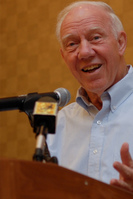
Jim Oberstar (D-MN). Photo: Jonathan Maus
But Oberstar’s early outline of the bill, which could get a vote in the committee as soon as next week, is already available. And it suggests that the Minnesota Democrat and Rep. Pete DeFazio (D-OR) have made good on their promises for a sweeping re-organization of the often debilitating federal transportation bureaucracy. Here are the highlights:
- The $450 billion price tag, which represents a 57 percent increase over the $286.5 billion bill approved in 2005, includes $87 billion in highway trust fund money for transit and $12 billion in transit cash from the Treasury’s general fund. The 2005 bill gave transit less than $44 billion in highway trust fund money and $9 billion from the general fund.
- Oberstar isn’t about to quietly accept Transportation Secretary Ray LaHood’s admonition that the 18-month extension is necessary to “face reality.” In fact, the committee’s outline of its bill warns that an extension could be devastating to state DOTs that have “been unwilling to invest in large, long-term projects until enactment of the reauthorization act.”
- Highway funding would be consolidated into four funding categories, as would transit—effectively eliminating 75 funding categories from the current system.
- Oberstar’s bill would establish the National Infrastructure Bank proposed by Rep. Rosa DeLauro (D-CT) and other senior lawmakers, making the bank part of a broader metropolitan access program that would support urban areas in achieving “improved transit operations, congestion pricing, and expanded highway and transit capacity.”
And that’s not all. Oberstar also appears poised to support “complete streets” principles in his bill, although his outline uses the phrase “comprehensive street design principles.” The forthcoming House bill would also ask the Environmental Protection Agency to set national emissions reductions targets for the transportation sector, thus requiring state and local official to keep climate change in mind when planning future projects.
Oberstar’s outline also attaches a number to the transportation funding gap that would result if existing law were relied on. Extending the 2005 federal bill for the next six years would result in $326 billion in funding, according to the House transportation committee—about $125 billion less than the new bill Oberstar wants.
Of course, the missing piece is how to pay for that increased infrastructure investment. The revenue puzzle falls under the jurisdiction of House Ways and Means Committee Chairman Charles Rangel, however, meaning that Oberstar’s will to fight LaHood on an extension may come down to how many allies the transportation chairman can find outside of his own committee.
Stay tuned.
Cross-posted from Streetsblog.