Transit
The evolution of Metrorail, 1976-2010
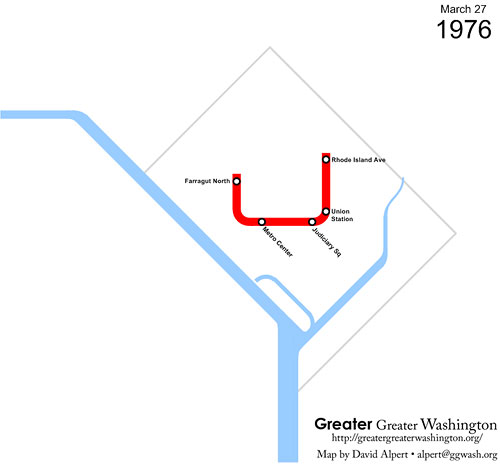
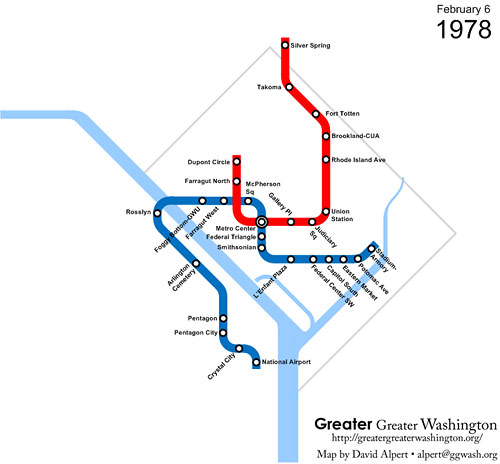
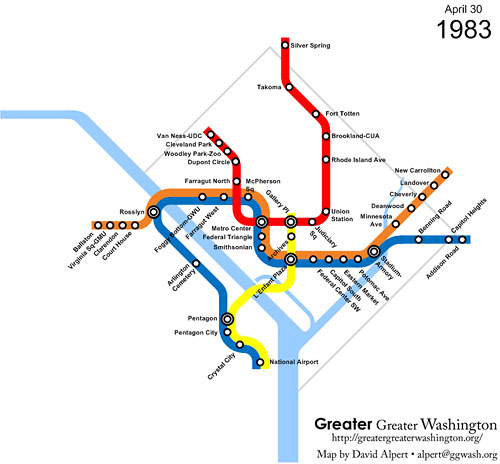
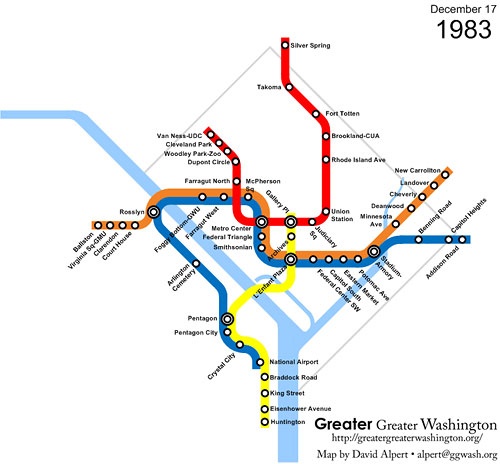
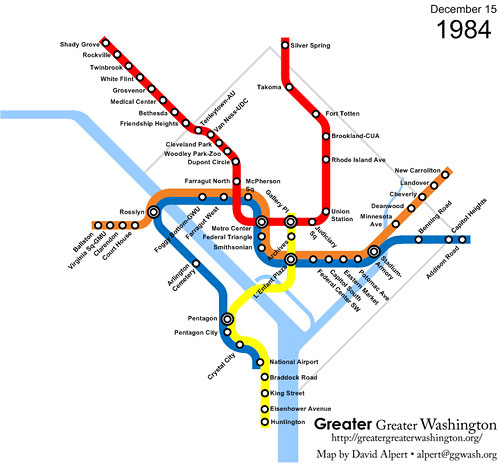
During December's snowstorm, we wrote that the worst December storm since 1982 would (and did) create a Metro system with about the same number of stations as in 1982, as did this weekend's storm.
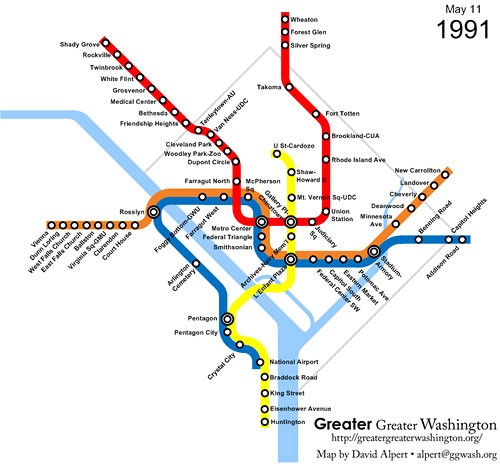
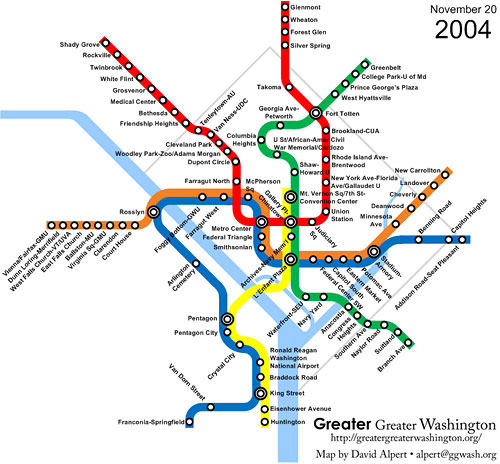
This raises the question, what exactly did the rail system look like in 1982? Or other years? To answer that, I created a little slideshow:
Most of the data comes from the excellent nycsubway.org timeline of the Washington Metro. I tried to identify the dates of station renamings from Wikipedia's pages on individual stations and other online sources. To keep the number of maps manageable, and because many stations' exact renaming dates are not available, I grouped station renamings in with the next major service change.
We know that around 1982, Orange and Blue trains operated a strange service pattern where Orange trains ran to New Carrollton, then turned around as Blue trains to run to National Airport; Orange trains the other way went to Ballston, then turned around as Blue trains to Addison Road.
According to coneyraven, this balanced the capacity as the New Carrollton and National Airport branches had higher ridership than the Ballston and Addison Road branches, while keeping the termini the same as their ultimate configurations (i.e. to get to New Carrollton, get on an Orange train).
I don't have information on whether Metro used this pattern for the entire time between when the line to Addison Road opened on December 1, 1979 until the Yellow Line opened on April 30, 1983; the maps above assume that is the case.
The maps do not show the Green Line Commuter Shortcut, where from January 27, 1997 until the inner Green Line opened in September 17, 1999, rush hour Green Line trains on the Greenbelt segment used the switch at Fort Totten to continue to Farragut North. Metro maps from that era do not appear to show this service except in an info box.


by Alex B. on Feb 8, 2010 10:41 am
Thanks!
by Erik on Feb 8, 2010 11:17 am
Too bad your license is CC-BY-NC so Wikipedia can't benefit from these images.
by Fritz on Feb 8, 2010 11:20 am
by Eric F. on Feb 8, 2010 11:27 am
Why was the Rhode Island Ave - Farragut North Stretch opened first.
I still dont see the logic of the blue/orange line thing
What took so long for trains in SW & SE & in Petworth/Columbia Hgts; why not add those first before the northern PG county green line.
by kk on Feb 8, 2010 11:34 am
by coneyraven on Feb 8, 2010 11:37 am
by Alex B. on Feb 8, 2010 11:41 am
by coneyraven on Feb 8, 2010 11:44 am
by Kevin on Feb 8, 2010 11:44 am
by David Alpert on Feb 8, 2010 11:57 am
by NikolasM on Feb 8, 2010 12:19 pm
by Cyrus on Feb 8, 2010 12:32 pm
by Dee on Feb 8, 2010 12:50 pm
by Gavin Baker on Feb 8, 2010 12:54 pm
It would be really cool to overlay each slide of this with some sort of economic development metric (average rent/home sale prices? per capita income? sales tax revenue?) to see how neighborhoods with metro stations compare to those without.
by stacy on Feb 8, 2010 12:59 pm
by Reza on Feb 8, 2010 1:30 pm
by Neil Flanagan on Feb 8, 2010 2:12 pm
by Shawn on Feb 8, 2010 2:41 pm
A petition that only calls for more money and completely ignores the need for better management, better customer service and better communication with the riding public is weak.
by Unsuck DC Metro on Feb 8, 2010 3:25 pm
by ccort on Feb 8, 2010 3:32 pm
bah.
by Jesse on Feb 8, 2010 3:43 pm
by Jimmy on Feb 8, 2010 5:02 pm
by David Alpert on Feb 8, 2010 5:11 pm
by Gavin Baker on Feb 8, 2010 5:20 pm
Also, did DC Government or Metro ever consider one time having a garage build at Rhodes Island and/or New York/Florida Ave? Because so many commuters from Maryland could take the Metro to/from work.
by Dave on Feb 8, 2010 10:01 pm
by Lib on Feb 8, 2010 10:07 pm
More subways! Everywhere!
by anonymiss on Feb 8, 2010 11:44 pm
by Jasper on Feb 9, 2010 6:47 am
------------------
Question - Required - Which e-mail alerts are you interested in receiving?
Alerts & Events
News for Residents of DC's Ward 3
by Jasper on Feb 9, 2010 8:43 am
I would still encourage everyone to sign up for their general list; they send out very important action alerts, and not too frequently.
by David Alpert on Feb 9, 2010 5:45 pm
by Jasper on Feb 9, 2010 8:45 pm
by JasonP on Feb 9, 2010 11:16 pm
The Metro system has always been shown in its entirety, even when lines were merely planned or their routing was still up in the air (think Green Line in the 80s), the system map still showed those lines and stations, just in a way to convey that they were not operational.
This slideshow shows the system as it expanded from its conception, without the distraction of the yet-to-be finished segments. Truly an evolution to behold.
by Reza on Feb 10, 2010 1:35 am
Interesting that you mention the maps that showed the entire system (finished and planned) --- Remember in the 80's when the southern branch of the Green Line was, for a time, planned to go outside the beltway to Rosecroft? Those maps weren't up for too long.
by coneyraven on Feb 10, 2010 8:43 am
by Jasonp on Feb 10, 2010 12:30 pm
by Fritz on Feb 10, 2010 1:19 pm
by Gavin Baker on Feb 10, 2010 1:30 pm
by Dave on Feb 10, 2010 3:34 pm
If the purple line consist of people going outside and leaving stations to transfer to either the red, green or orange lines than it should not be a line since it is inherently different from the others; if its transfer points are like other typical metrostations (Le'Enfant Plaza, Ft. Totten, Gallery place, Metro Center)than it should be considered a line.
by kk on Feb 10, 2010 6:32 pm
by JasonP on Feb 12, 2010 10:12 am
Your slideshow shows the evolution of what was actually built and the service that was implemented.
What your slideshow fails to show is the evolution of the alignment changes, additions, subtraction and how the service that exists today differers from what was shown on the system map when Phase I opened on 03 27 1976.
by Sand Box John on Feb 18, 2010 10:01 am
by David Alpert on Feb 18, 2010 12:16 pm
by Shipsa01 on Aug 17, 2010 4:18 pm
I was at the RI Ave dedication, 03-27-76 and on the 1st regular revenue train in service on Monday.
I still have the original System map from 1972. I've also kept all my work notebooks since July 24, 1974. it's been fun and sad at times.
by vinny on Sep 27, 2010 7:46 pm
@ Vinny, very impressive, I'd love to see what you have ... I've been one of the lucky ones to have acquired a roll sign from a Rohr Car ... definitely the prize of my collection, that and the system map showing the alignment to Rosecroft (Green Line)
by coneyraven on Sep 28, 2010 4:50 pm
by Phil Duff on Feb 13, 2011 12:31 am
by coneyraven on Feb 13, 2011 9:42 am
by Froggie on Feb 14, 2011 10:21 am
I like your urban planning approach and note that your reading list is on track. I have been thinking urban planning and livability for 50 years and believe that we have a lot of common interests. I am orange line from Falls Church and think constantly about the next generation of public transit and the organization of the transit to fit the current and future communities. I am an advocate of the quiet, friction free superconducting Maglev system, invented in this country by my colleagues, Drs. James Powell and Gordon Danby. Their system was developed by Japan and holds the worlds speed record for transport. Powell and Danby's 2nd generation system is even better, their new 4-pole magnets are powerful enough to lift trucks (allowing a lot of deliveries to be made during the night and unclog our roadways. The system guideways are spectacular. The new system operates in a planar mode and can operate on conventional RR trackage that has been adapted for Maglev for ~$6 million a 2-way mile. This capability also allows the system to uniquely electronically switch allowing flexibility in station spacing and operating express routes on the mainline trackage.
This is the inevitable system for the 21st Century and if you think there is interests in planning a 2nd generation superconducting Maglev evolution of the Washington Metro let me know and we would do a plan for WMATA so that the authority would have some idea of what it would cost and how much they would save in operating costs due to much lower electric power requirements and much lower track maintenance costs. Another super advantage of the system is that it could be integrated with a high-speed national Maglev Network. You could catch a Maglev vehicle at any metro station and if there are enough passengers the vehicles could proceed to a destination anywhere in the country at 300 mph, once the vehicles joined the elevated high speed guideway. Or at any of the existing multimodal hubs ultra high speed Maglev service could be connected to the Interstate system. Thanks for the great Website. I signed up and hope that we can continue to blog on this issue. James Jordan, President Interstate Maglev Project and Excutive VP of MAGLEV2000.
by Jim Jordan on Aug 13, 2011 7:04 pm
I like your urban planning approach and note that your reading list is on track. I have been thinking urban planning and livability for 50 years and believe that we have a lot of common interests. I am orange line from Falls Church and think constantly about the next generation of public transit and the organization of the transit to fit the current and future communities. I am an advocate of the quiet, friction free superconducting Maglev system, invented in this country by my colleagues, Drs. James Powell and Gordon Danby. Their system was developed by Japan and holds the worlds speed record for transport. Powell and Danby's 2nd generation system is even better, their new 4-pole magnets are powerful enough to lift trucks (allowing a lot of deliveries to be made during the night and unclog our roadways. The system guideways are spectacular. The new system operates in a planar mode and can operate on conventional RR trackage that has been adapted for Maglev for ~$6 million a 2-way mile. This capability also allows the system to uniquely electronically switch allowing flexibility in station spacing and operating express routes on the mainline trackage.
This is the inevitable system for the 21st Century and if you think there is interest in planning a 2nd generation superconducting Maglev evolution of the Washington Metro let me know and we would do a plan for WMATA so that the authority would have some idea of what it would cost and how much they would save in operating costs due to much lower electric power requirements and much lower track maintenance costs. Another super advantage of the system is that it could be integrated with a high-speed national Maglev Network. You could catch a Maglev vehicle at any metro station and if there are enough passengers the vehicles could proceed to a destination anywhere in the country at 300 mph, once the vehicles joined the elevated high speed guideway. Or at any of the existing multimodal hubs ultra high speed Maglev service could be connected to the Interstate system. Thanks for the great Website. I signed up and hope that we can continue to blog on this issue. James Jordan, President Interstate Maglev Project and Executive VP of MAGLEV2000.
by Jim Jordan on Aug 13, 2011 9:00 pm
by David Miller on Mar 6, 2012 12:21 am
by Dave Murphy on Mar 26, 2012 4:24 pm
Add a Comment