
Strip malls won’t help Wheaton redevelopment
In February 2008, El Pollo Rico burned down, taking half a block of downtown Wheaton with it. Over two years later, the site at Ennalls Avenue and Veirs Mill Road is filled once again. But the new shopping center, called Triangle Park, may not an improvement on what was there before.


Left: the shopping center after the fire in 2008. Right: Triangle Park today.
Triangle Park was developed by Greenhill Capital and designed by Steven J. Karr. Together, they’ve built dozens of buildings in Montgomery County over the past thirty years, including sixteen in downtown Wheaton.
Almost all of Greenhill’s properties in Wheaton are small retail strips like Triangle Park and Georgia Crossing, located at Georgia Avenue and University Boulevard and where El Pollo Rico relocated after the fire. That three-building, twenty-five space complex has four occupied stores.
Meanwhile, Triangle Park has nine spaces, five of which are also vacant. Many former Greenhill tenants — small businesses like DeJaBel Cafe and Hollywood East, have complained of unfairly high rents and mistreatment, forcing them to close.

Triangle Park’s parking lot.
There’s a serious lack of vision on the part of Greenhill, who had architect Karr design a mixed-use complex for the Georgia Crossing site, then built a strip mall instead, all the while blaming the county and the community for dropping the ball on necessary zoning changes. The economic downturn killed any potential for a more ambitious project, Karr complained.
Regardless of the economy, it seems like Greenhill wouldn’t have had twenty-six vacancies in their new shopping centers if there were people living and working on top of them, providing business for stores who otherwise wouldn’t have enough customers. And when the market does improve, Wheaton will have lost several prime development sites.
Triangle Park and Georgia Crossing are centrally located at the intersection of three major state highways, dozens of bus routes, and a Metro station. Young, affluent singles and families are moving in - the target audience for the kind of urban center planners are trying to create here. A little foresight could’ve gone a long way to making these projects an asset to the community, rather than more of what we’ve had in the past.
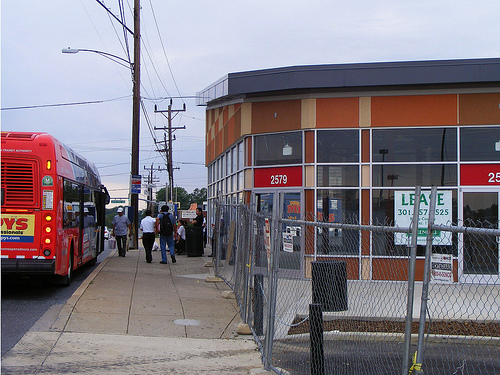
Boarding a bus next to Triangle Park.
Greenhill holds 41 of 150 properties in downtown Wheaton, according to this Gazette article. With Westfield, who owns Wheaton Plaza, and B.F. Saul, who was given 8.2 acres around the Metro to rebuild, they are one of just three major developers in the area.
That may make redevelopment easier. After all, the land is already assembled. But when that land is tied up by risk-averse owners who’d rather build to make a quick buck than consider the long-term possibilities, a bright future for Wheaton seems more elusive than ever.